Weekly Brief No. 11 ·
State of Play now sets India, Singapore, Hong Kong, Japan and South Korea side by side
From 16 November every State of Play entry covers Japan and South Korea as well as India, Singapore and Hong Kong, and the five markets are furthest apart on whether regulated institutions may use a public chain. On Ethereum, the core developers wait for outside audits before they revise Glamsterdam.
From 16 November 2026 every State of Play entry covers Japan and South Korea alongside India, Singapore and Hong Kong, and the five markets are furthest apart on whether regulated institutions may use a public chain. In the week of 9 November the Ethereum Foundation (EF) asked the core developers to wait for public audit findings before they revise Glamsterdam, and Ethlabs proposed that every Ethereum account be able to move to post-quantum signatures in 2027.
State of Play across five markets
A single consultation, licence or pilot seldom changes what an institution in these markets can do. A bank, issuer or fund manager plans against the position those events add up to: whether it may issue on a public chain, which money settles a tokenised trade, who may issue a stablecoin. The Regulatory Wire records each event. State of Play keeps the position on each long-running question, one entry per question, with every change dated and sourced. From 16 November each entry sets Japan and South Korea beside India, Singapore and Hong Kong, so a rule in one market can be read against the other four on one page.
For Ethereum the widest split is on regulated finance on public blockchains. Singapore and Hong Kong allow regulated institutions to issue on public permissionless chains, and both attach the permission to controls in the token: whitelisted holders, and issuer powers to freeze or correct (Monetary Authority of Singapore; Securities and Futures Commission, SFC). Japan has no rule on public chains for regulated issuers, and JPYC, a registered funds transfer service provider, has issued its yen stablecoin on Ethereum mainnet with open access since October 2025. SBI Shinsei Trust Bank keeps its JPYSC stablecoin inside SBI VC Trade accounts until its treatment under law and tax practice on public chains is settled. South Korea’s draft rules for tokenised securities require a ledger shared by at least two account management entities and the Korea Securities Depository, a consortium design that an Ethereum Virtual Machine (EVM) client could still meet. India’s regulated tokenisation runs on ledgers owned by its depositories (Securities and Exchange Board of India), and no Indian regulator has set out a path to public chains.
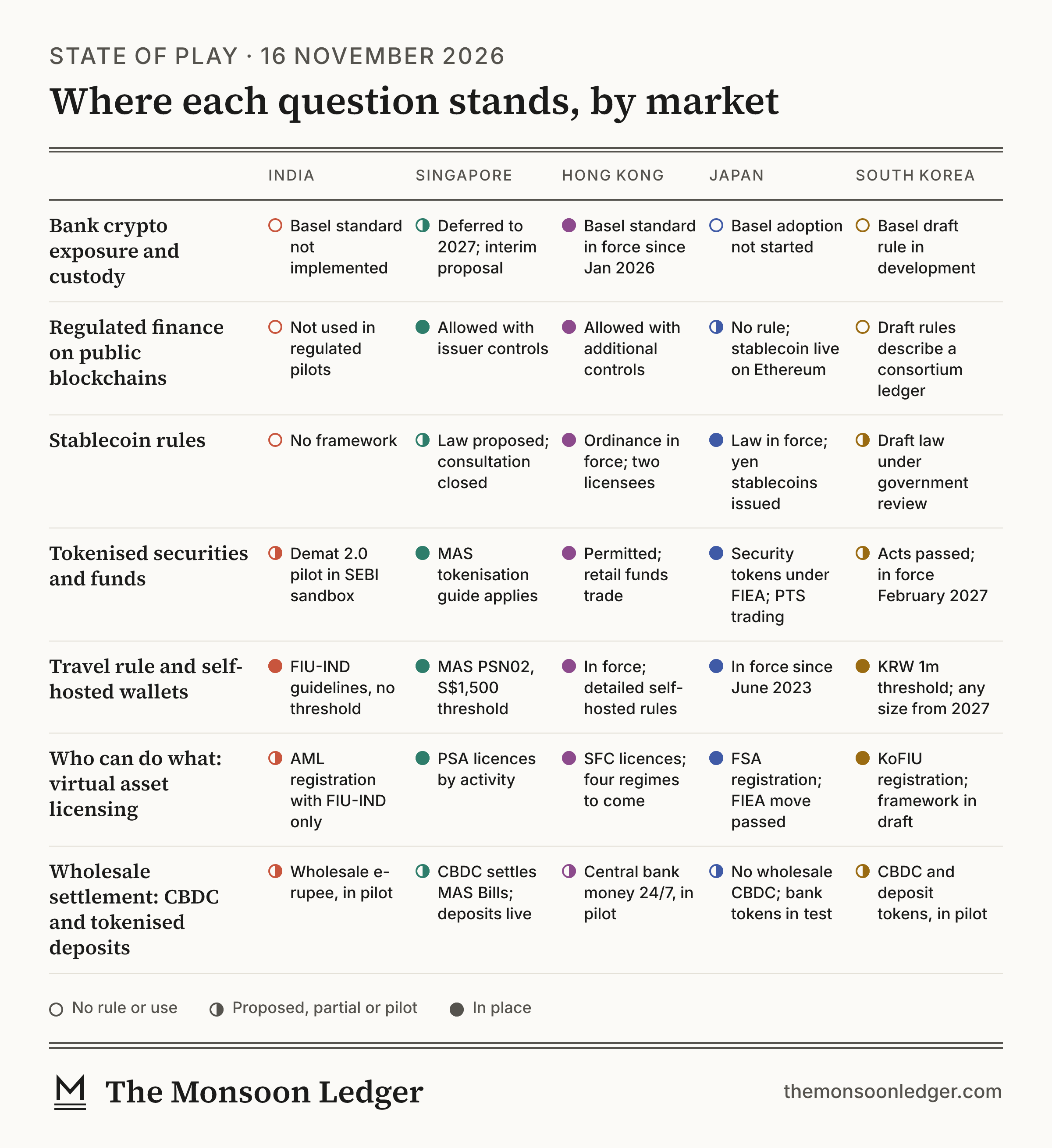
Each question has its own entry, with the position in each market, its sources and every change to it: public chains, stablecoin rules, tokenised securities and funds, wholesale settlement, licensing, travel rule and bank crypto exposure.
Technology
Glamsterdam waits for outside audits
On 9 November the EF updated its post on EIP-8037 and EIP-8038, the Glamsterdam proposals that raise the gas Ethereum charges for creating and reaching state. Four reports had found deployed contracts that could break under the changes, and the EF recommends that All Core Devs (ACD), the developers’ coordination calls, wait for public audit findings from ChainSecurity and Dedaub before revising the specifications or setting a date for the Hoodi testnet. The two firms present their findings on the Testing call on 16 November, and the Execution call discusses them on 19 November (EF). The EF set 13 November for the reports, but the Testing call agenda says “completion expected 16th-19th Nov” (Ethereum Magicians, ACDT #103), and on 14 November the EF’s invariants repository listed none. The update names no contract or protocol. Hong Kong’s licensed HKDAP stablecoin and the tokenised funds listed in Weekly Brief No. 10 run on Ethereum mainnet, and whether any of them is among the four reports is not public.
A post-quantum target for Ethereum in 2027
On 11 November Caspar Schwarz-Schilling of Ethlabs, an EF spinout, proposed that Ethereum become “post-quantum and post-AI in 2027” (AI is artificial intelligence), meaning that consensus and every account have a route to signatures that a quantum computer cannot break, at Glamsterdam’s capacity. The post says Ethlabs “will withdraw quick slots from Hegotá”, the faster block time it had backed for the upgrade after Glamsterdam, and dedicate its resources to this target. For Hegotá it proposes shipping Frame transactions with SPHINCS, a post-quantum signature scheme, and other post-quantum account proposals on the execution layer, plus migration tooling for wallets and for validators’ keys, including institutional staking setups. It cites the US government moving its quantum-risk deadline from 2035 to 2030. The 12 November Consensus call agenda asked “What level of urgency should we have around the post-quantum and/or post-AI landscape?” (ethereum/pm #2291). The post is Ethlabs’ view, and the core developers have not adopted it. It does not discuss tokens whose issuer, admin or whitelist keys use today’s signatures, as the licensed tokens from Hong Kong and Singapore on mainnet do.
On the site
- Regulatory Wire: Japan and South Korea items from January to November 2026 (Japan; South Korea), 16 November.
- Under the Hood: A Hong Kong tokenised fund now trades at any hour, and a trade leaves the token on Ethereum where it is, 11 November.
- State of Play: Who can do what: virtual asset licensing, updated for the SFC conclusions on restricted names for crypto exchanges and token trading platforms (Regulatory Wire, 6 November), 11 November.
What to watch
- 16 November: All Core Devs Testing call #103, with the status of the Glamsterdam audits and an open question session on their findings (Ethereum Magicians).
- 17 November: the first breakout call on post-quantum consensus (Ethereum Magicians).
- 19 November: All Core Devs Execution call #249, with Glamsterdam on the agenda (ethereum/pm #2285) and the audit findings to be discussed (EF).
- 30 November: comments close on the MAS proposal that licensed stablecoin issuers join the Financial Industry Disputes Resolution Centre (Regulatory Wire; State of Play).
- 31 December: Hong Kong’s insurer capital rules for crypto assets and licensed stablecoins take effect (State of Play).
- 1 January 2027: Hong Kong starts the Crypto-Asset Reporting Framework (CARF) (Regulatory Wire).
- 4 February 2027: South Korea’s law on tokenised securities takes effect (Regulatory Wire).
- No date: a new Hoodi date for Glamsterdam (EF).